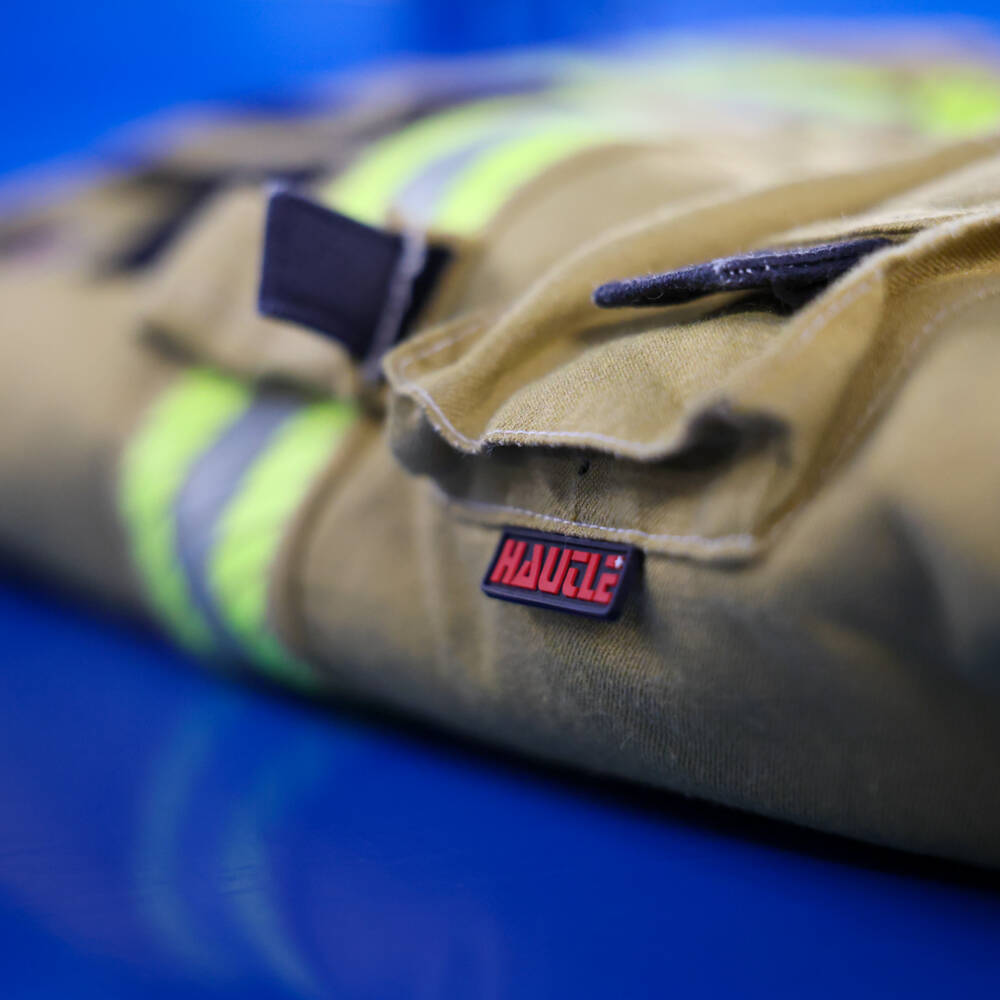
Uncompromising standards—in people, materials, and cutting technology
When seconds determine life or death, every detail counts. In their line of duty, firefighters rely on their protective gear. Nobody knows this better than Gallus Hautle AG. With its high quality standards and comprehensive service, the company has earned itself an outstanding reputation with fire departments across Switzerland. In this context, the Zünd digital flatbed cutting system plays a pivotal role in the production workflow of protective clothing.
A flashover can turn a fire into an inferno within seconds. For firefighters, in moments like these, it's not just their experience that determines life or death—it's also their personal protective equipment (PPE). Depending on the protection class, the PPE is suitable for exterior firefighting or for interior operations with a risk of flashover. Hautle AG Executive Board member Andreas Studer describes the worst-case scenario: “In such cases, a turnout jacket must withstand temperatures of 1,000 degrees or more and reliably protect the firefighters. Such protective equipment must therefore meet rigorous standards and be certified accordingly.” Professional and volunteer fire departments throughout Switzerland rely on custom-made solutions from Hautle.
Specialists in uncompromising quality
The family-owned company based in Wittenbach, Switzerland, has specialized in the development and manufacture of PPE for over 50 years. With its roots in military clothing production, Hautle now focuses on high-quality protective clothing for fire departments and other emergency services. Hautle is regarded as a quality leader throughout Switzerland—not least because the company offers far more than just manufacturing. Hautle covers the entire life cycle of its equipment, from custom measurements and manufacturing to cleaning, repair, and logistics. Hautle employs a total of 34 people at its Wittenbach and Rancate locations and is led by Maria Hautle, a second-generation member of the family.

Rancate – where the protective clothing is made
At its site in Rancate in southern Switzerland, Hautle once produced rainwear for the Swiss army, but today it manufactures protective clothing there. In the workshop near the Italian border, sewing machines stand in neat rows. Here, 18 employees stitch together cut pieces for the protective clothing. A sewing workshop with a strong emphasis on craftsmanship, one might think; but appearances can be deceiving. Behind this craftsmanship lies an extremely sophisticated end-to-end system. For the past two years, state-of-the-art digital cutting technology from Zünd has been at its core.

Personal protective equipment
Personal protective equipment is challenging in many respects. This custom-made gear must meet the highest standards for fire and cut protection. All materials involved, down to the sewing thread, are classified in different fire protection classes and rigorously tested.
A turnout jacket consists of up to 150 individual parts, each precisely manufactured. At the same time, each piece is unique, with different body measurements and specific requirements—combined with small batch sizes in production. Special textiles such as Nomex or Kevlar are used as outer fabrics, enabling turnout jackets to withstand heat, flames, and mechanical stress. Additional features include special thermal liners, moisture barrier membranes, joint protectors, anti-wicking barriers, storm cuffs, etc.
Nomex is a meta-aramid developed by DuPont for heat and flame resistance, while Kevlar is engineered for very high tensile strength and impact resistance. Processing these specialty textiles makes cutting extremely challenging. Hautle was a pioneer in cutting and processing Nomex as far back as the 1990s. This was a milestone for fire departments that had previously relied on rubberized protective gear. “Nomex is both flame-resistant and breathable and quickly gained acceptance thanks to its excellent comfort and overall wearability,” explains Studer.
When processes reach a tipping point
With sophisticated and costly materials, rising demand, and increasing product variety, cutting became a critical factor. Manual multi-ply cutting using handheld knives created a bottleneck in the cutting room. It was critical not only in terms of capacity, but above all for ensuring process stability and efficient material utilization. With material accounting for up to 50% of total costs, any unnecessary waste has an immediate impact. For Studer, the minimal waste and resulting high level of material efficiency are among the key arguments in favor of single-ply cutting with the Zünd G3 cutter. “The materials are very expensive. It is therefore crucial for us to keep material consumption as low as possible. Moreover, multi-ply cutting would not be feasible simply due to the fabric's high Kevlar content.”

Moving toward digital process logic
The decision to transition to digital cutting with a Zünd G3 L-2500 was the next logical step in optimizing production processes. Today, the Zünd G3 cutter is an integral part of an end-to-end digital workflow. For new gear, Hautle takes measurements on site at the fire departments. The data is then digitized, unless the required sizes are already in the system. The software then creates the corresponding cut parts from the measurement data. For nesting and placing the cut parts, Hautle relies on MindCUT software from Portuguese software partner Mind. To better keep track of cut parts during off-loading, pieces for each size are grouped together. Automatic nesting has further increased material efficiency. “It allows us to cut even closer to the edges and further improve material utilization.”
Precision as the foundation for stability
The biggest change is not just in speed, but in the overall quality of the process. Upstream and downstream process steps have also been affected: Paper patterns are a thing of the past. Notches are placed automatically, and cut parts are now available in digital form—for repairs or reorders, for instance. This makes cutting not only more efficient, but above all more predictable and stable. “Modern uniforms have more parts and more complex shapes than they used to. The Zünd cutter cuts them much more precisely than a person using a straight knife.”

A unique all-inclusive service
From measurement to production, storage, cleaning, and repair, Hautle handles the entire logistics process for fire departments and other emergency services as a full-service provider. And this is what makes it unique and a cornerstone of the company’s success. If individual parts of a garment need to be replaced, they can be called up in the software at the push of a button and produced on the Zünd cutter in no time. Studer: “We can produce quickly and offer everything—from washing and equipment inspection to repair and logistics—from a single source. This is one of our key differentiators.”

A system you can rely on
Today, the cutter runs almost non-stop and has become a key element in the production process. Its importance extends beyond just cutting. It sets the pace, synchronizes processes, and lays the foundation for all downstream production. That's why reliability and service are critical: “You can rely on Zünd's service and support. If the cutter is operating non-stop and essentially the heart of the production workflow, downtime quickly becomes a huge problem.”

Technology in the background – safety in the line of duty
As much as the production processes at Hautle have changed, the goal remains the same: In the line of duty, firefighters must be able to rely on their equipment. This level of safety cannot be achieved through materials or workmanship alone. It can only be achieved through the precisely coordinated interplay of craftsmanship, digital processes, and reliable technology. Zünd provides the foundation for this, enabling customers like Gallus Hautle AG to consistently deliver on their high quality standards.
