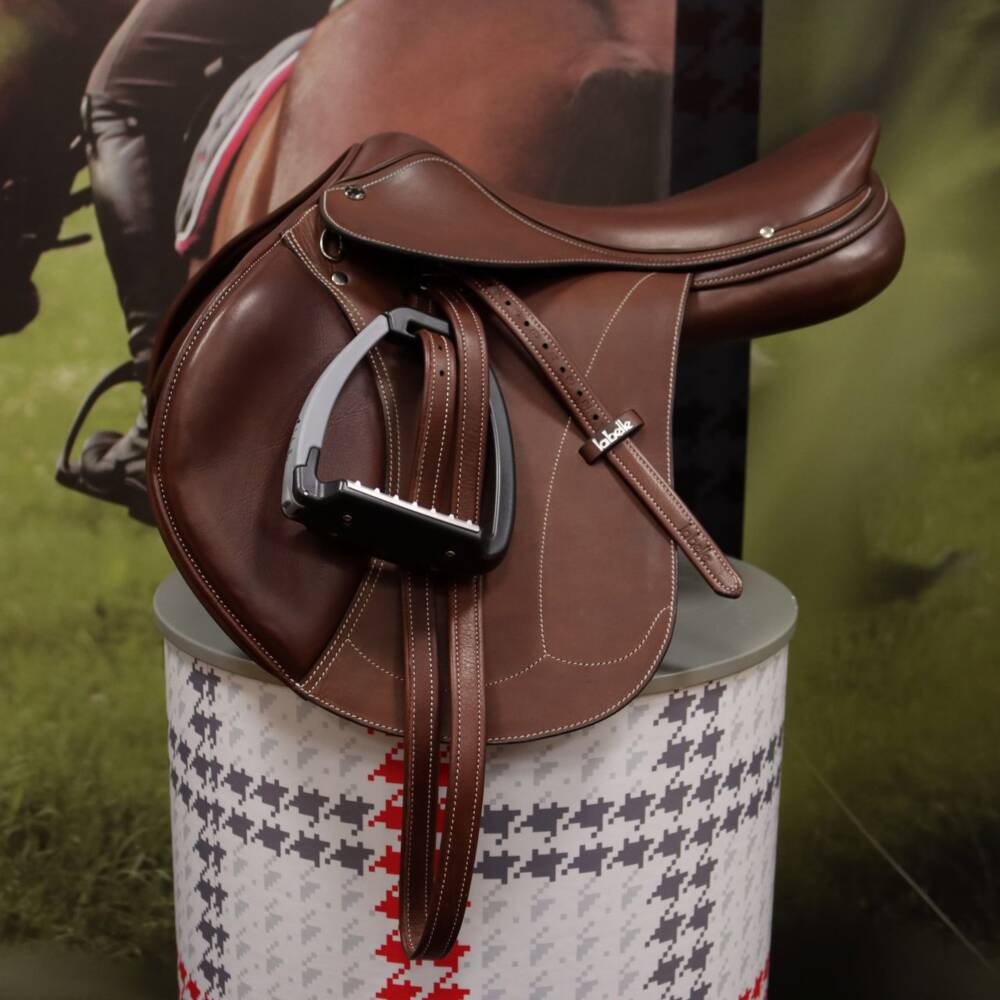
What the greatest happiness on Earth has to do with a Zünd Cutter
At the La Belle Sattel saddlery in Herisau, Switzerland, traditional craftsmanship and modern technology go hand in hand. Where hand shears and patterns once ruled, digital precision now leads the way. A Zünd digital cutting system offers the team around Philipp and Marianne Seiler new creative options, ensures consistent quality, and helps secure the future of a profession shaped by centuries of experience. This is a story of a bold move toward digitalization that strengthens, rather than replaces, the saddler's craft.
The workshop at La Belle Sattel saddlery in Herisau, in eastern Switzerland, is bustling with activity. The scent of leather hangs in the air. Here, high-quality saddles for recreational riding, dressage, and show jumping are crafted by hand, with precision and a wealth of expertise. Each saddle is custom-made, meticulously crafted to fit the horse’s back perfectly.
At the center of the workshop is a clear sign of the saddlery’s embrace of modern technology: Since fall 2025, a Zünd G3 XL‑1600 cutting system, together with a projection solution and MindCUT software, has supported the 15‑person team in the digital cutting process.
There's a saying that the greatest happiness on Earth
is found on the back of a horse. And the greatest
potential for optimizing digital cutting is found in a Zünd cutter.

Traditional craftsmanship meets digital precision
Even today, it is by no means a matter of course for leather, foam, latex, and felt to be cut digitally. Saddlery is a craft rooted in tradition. From measuring the horse’s back and fitting the saddle tree to stitching and covering, much of the work is deliberately done by hand to precisely control both fit and appearance.
For owner Philipp Seiler, himself a passionate show jumper, stepping into a digital future was a conscious decision—even though he is not a digital native. Growing up on a farm that bred horses and ran a carriage business, he discovered his passion for riding and leatherwork at an early age.
A trained saddler, he began working in 1998 for what was then Rolf Weishaupt Sattlerei. The business was renamed La Belle Sattel in 2005 and taken over in 2020 by Philipp Seiler and his wife, Marianne Seiler.
With their high-quality, custom-made saddles, the Seilers have made a name for themselves in the equestrian community in Switzerland and abroad. Their success is built on consistent quality—and smart investments. “For years now, we’ve been thinking about how digital technology can effectively complement our manufacturing processes,” says Seiler.
Investing in a digital cutting solution from Zünd was, for Seiler, the next logical step towards the future: “The digitalization of cutting has brought about a profound cultural transformation in our company.” Finding skilled staff is a challenge, he adds. Today's demand is for modern working environments, smart tools, and companies that have the courage to embrace change. But for La Belle Sattel, the move from labor-intensive manual cutting to digital cutting was not just an investment in precision, profitability, and efficiency. It is also a commitment to the future of saddlery as a craft.

A saddle as unique as the horse and rider
Saddles are as varied as the riding disciplines they are used for. Dressage saddles are designed to keep the rider in an upright position on the horse, while flat jumping saddles allow for bent legs and maximum freedom of movement. Seiler visits each horse and rider personally to get a clear sense of both and take the necessary measurements. “Many people have slightly angled hips, for example. I pay attention to such details.” The shape of a horse’s back is influenced not only by its breed, but also by its age. The saddle must adapt precisely to the horse’s back—and grow with it. After all, the custom-made saddles from La Belle Sattel are designed to last between 10 and 15 years.
For both horse and rider, the saddle is the point of comfort. “It provides support and distributes the rider’s weight evenly across the horse’s back,” Seiler explains. The saddle tree forms the structural foundation, while the saddler’s individual skill ensures a perfect fit. Each saddle is custom-made and must fit—or be made to fit—as the link between horse and rider. While a quality saddle offers us comfort for many years, the situation looks quite different from the horse’s perspective: as muscles change during training, the saddle requires regular adjustment. It is therefore advisable to consult an experienced saddler right from the start when purchasing a new saddle.
Asked what a horse would prioritize, Seiler smiles: “A perfectly fitted soft saddle with the lowest point in the right place—not too far back. No abrasive seams. And probably a rider who is not too heavy and maintains good balance.”

The saddle tree – the core of the saddle
A saddle consists of some 30 individual parts. Saddles can be made from a variety of cowhides and calfskins—ranging from thick and firm to thin and supple—along with felt and sheep’s wool.
The heart of the saddle is the saddle tree, crafted from beech wood by a Bernese wheelwright. Quality and precision are paramount for Seiler here as well. The saddle tree is webbed with straps, giving it its final shape. Latex or foam is then applied to the covered tree (for jumping saddles), followed by various leather pieces that have been sewn together beforehand. The seat leather is stretched over the saddle tree while still wet. This allows La Belle Sattel to cover the saddle’s curves smoothly and without wrinkles. “This meticulous approach is our trademark,” says Philipp Seiler proudly.

Digital cutting for better quality and efficiency
Where paper patterns and hand shears were once the norm, cutting patterns are now created on a computer, interactively placed on the leather using the Zünd G3 and cut with millimeter precision. This digital workflow is especially advantageous when it comes to repairs: damaged parts can be digitally captured and accurately reproduced on the Zünd cutting system. “I can use the cutter to make parts that would be impossible to produce by hand with the same level of quality,” says Seiler.
Seiler never saw the purchase of the cutting solution as a purely financial investment. He brought his whole team along on a visit to Zünd. It proved to be a pivotal experience for all involved . “My team got a first-hand view of how digital technology supports modern production workflows. They found it compelling—and inspiring.”
For Seiler, one thing is clear: “I can only be successful as a producer in Switzerland and hold my own internationally if I think innovatively, act accordingly, and regularly review and optimize our processes.” Investing in a Zünd digital cutting system is therefore not only pragmatic—it also strengthens the competitiveness of a Swiss custom manufacturer that is committed to quality, precision, and the use of premium materials and regional resources.
Roughly 20 hours of manual craftsmanship go into every saddle from La Belle Sattel—supported by modern digital cutting technology from Zünd. Capacity is fully booked: Customers placing an order today can expect to wait at least two months before their horse is fitted with a new saddle.
